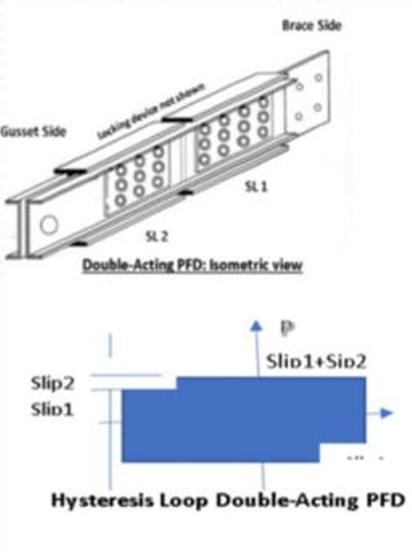
Multi-Load Performance-Based Friction Damper (ML-PFD) / Double-Acting PFD
The Multi-Load Performance-Based Friction Damper (ML-PFD), or Double-Acting PFD, is an advanced hysteretic energy dissipation device developed to achieve multiple seismic performance objectives within a single damping unit. Unlike conventional friction dampers that operate at a single slip load, the ML-PFD incorporates two sequential activation thresholds: a primary slip load (SL1) corresponding to the Design Basis Earthquake (DBE) level and a secondary slip load (SL2) that engages under Maximum Considered Earthquake (MCE) demands.
This is achieved through a proprietary dual-stage friction mechanism incorporating a controlled gap within one friction assembly. During cyclic loading, SL1 activates first, providing early energy dissipation at lower force levels. As displacement demand increases and the gap is exhausted, SL2 engages, resulting in a multi-stage hysteretic response with enhanced energy absorption and improved control of structural demands.
The stepped hysteresis behavior enables 20–30% greater energy dissipation compared to conventional single-slip dampers, reducing peak structural responses, residual deformations, and overall damper requirements. Optimized slip-load ratios further ensure reliable performance across multiple hazard levels, often resulting in improved seismic resilience and project cost savings.
Due to its nonlinear staged activation and complex frictional behavior, accurate implementation of the ML-PFD requires specialized analytical modeling beyond the capabilities of conventional structural analysis software. To address this, a proprietary in-house software platform has been developed to simulate the device's multi-stage hysteretic response, optimize damper parameters, and support advanced Performance-Based Seismic Design (PBSD) applications.